Hamburg, Mumbai, and the Zoroastrian Ethics of a Connected World
A Hanseatic-Persian Reflection on the World Zoroastrian Youth Leaders Forum
When, for the first time, a participant from Germany was invited to the World Zoroastrian Youth Leaders Forum, he came from Hamburg. This might not merely be a coincidence, but a moment that reveals something about Hamburg itself: a city whose historical ethos, perhaps unexpectedly, resonates with the ethical architecture of one of the world’s oldest living religions and most cosmopolitan communities.
Hamburg has, for centuries, articulated a civic self-understanding that is both deceptively simple and remarkably radical. One of our oldest constitutional ideas can be captured in a phrase dating back to the medieval period: “There is no master above you and no servant below you.”
Hamburg’s Ordelbook of 1270 does not only make a political statement here, but offers an ethical framework for the centuries to come. It asserts equality not as an abstract aspiration, but as a lived principle, as an organizing idea of our society.
Complementing this is the equally enduring concept of the “Ehrbarer Kaufmann” (“honourable merchant”): a model of economic agency rooted not in maximization alone, but in responsibility. German novelist Thomas Mann, who was awarded the Nobel Prize in Literature in 1929, captured its essence through the voice of the Buddenbrook patriarch, who reminds us that the ultimate measure of success is moral, not quantitative: “My son, be zealous in business by day, but conduct only such affairs that we may sleep peacefully at night.”
It is tempting to treat such ideas as cultural anecdotes or local-patriotic folklore. Yet over centuries, they have proven to be structural. They have shaped institutions, behaviours, and expectations, contributing to Hamburg’s emergence as one of Europe’s most significant economic, political, scientific, and cultural ecosystems.
Scholars such as Prof. Dr. Dr. Wolfgang Michalski, long-time Director of the OECD’s Strategic Planning Unit, have emphasized that the city’s enduring success lies in its remarkable ability to adapt to the shifting dynamics of globalisation across economic, political, and social domains. In his analysis, Hamburg stands out as one of the rare urban systems that has consistently remained on the “winning side” of globalisation by embedding itself within evolving global networks and by embracing change as a structural principle.
For readers in India, and perhaps especially in Mumbai, this is not an abstract observation about a northern European city – yet another that fiercely protects its swans. Hamburg’s history of globalisation has long included the Indian Ocean world: shipping routes, commercial families, port infrastructures, political upheavals, diasporic memories, and the patient work of merchants who understood that trade is never only about commodities. In a more modern context, the Indo-German Chamber of Commerce, has since 1956, progressed this mission on a diplomatic and economic basis, with its own Hamburg chapter, The Hamburg Representation Mumbai, celebrating over 15 years of establishment. In recent years, with the progression of EU-India trade, accelerated by Brexit and new EU-India free trade agreements, Hamburg continues to become more embedded in Mumbai’s maritime world, and has sizeable market share in German-Mumbai trade. This is, in a sense, no surprise, as Hamburg’s relationship with India belongs not only to the history of Indo-German exchange, but to a deeper history of cities that have learned to think through the sea.
In Hamburg, this openness has never been merely transactional. Over time, the city’s integration into global trade and institutional frameworks has given rise to a broader cosmopolitan disposition: an openness not only to markets, but to people, ideas, and cultural traditions from across the world.
This may be one reason why Hamburg has repeatedly felt intelligible to Indian entrepreneurs, including those shaped by Parsi traditions of commerce and philanthropy. I do not mean this in a simplistic sense: companies do not choose cities because of poetry, and ports are not sustained by sentiment. They are sustained by infrastructure, law, access, discipline, and strategic interest. Yet durable economic relationships rarely rest on calculation alone. They also depend on a sense that one’s counterpart understands the grammar of responsibility: the value of reputation, the importance of reliability, the obligation to think beyond the immediate transaction. In this grammar, Hanseatic Hamburg and Parsi India seem to recognize something in one another, and From a Zoroastrian perspective, these old Hanseatic intuitions may sound strikingly familiar.
At the heart of Zoroastrianism lies a principle of profound clarity, known to many Persians far beyond the community of Zartoshti believers itself: “Humata, Hūxta, Huvaršta”, or good thoughts, good words, good deeds. The step further, one may argue, is interpreting this mantra through the lens of the “good mind” or “vohu manah”. This is where integrity, long-term relationships, peace, and mutual growth become relevant – for it is precisely this commitment to integrity that gives the Buddenbrook family and business ethos its enduring strength, even when the prevailing commercial conventions of their time, or indeed of our own, might favour a different course.
It is perhaps no accident that some of India’s most influential Parsi business families and conglomerates have understood enterprise in similarly expansive terms. Their legacy is not confined to industrial growth, although that alone would be remarkable. It also extends into education, science, hospitals, housing, art, urban development, and philanthropy. The point is not to idealize any family, company, or community. No commercial history is without ambiguity. But the pattern remains striking: business, in this tradition, is often imagined not as an escape from society, but as a way of assuming responsibility within it.
It is an ethic that locates responsibility firmly within the individual, yet understands that individual action is inherently embedded in a wider moral order. It rejects hierarchy as a source of legitimacy, and power as freedom from consequence, and instead emphasizes alignment between intention, expression, and action. It is, in this sense, both deeply personal and inherently social.
The parallels are not superficial. The honourable merchant’s concern for integrity echoes the Zoroastrian insistence on truthfulness and ethical action. The medieval Hamburgian idea of equality resonates with a moral anthropology that does not derive dignity from rank. And Hamburg’s long-standing cosmopolitanism, in its openness to trade and entrepreneurship, migration, and intellectual exchange, finds a counterpart in the diasporic, networked character of Zoroastrian communities across the globe.
Seen from India, this resonance also helps explain why Hamburg can appear as more than a logistical node in Europe. For Parsi-rooted enterprises and families, whose histories are so often intertwined with ports, law, trade, public service, and philanthropy, Hamburg offers a familiar moral landscape in an unfamiliar geography, and it is no surprise that over the years, many Zoroastrians have made their homes and lives there. It is not Mumbai, but it shares with Mumbai the knowledge that a city open to the world must be held together by something more than movement. It needs norms, memory, trust, and a certain civic seriousness.
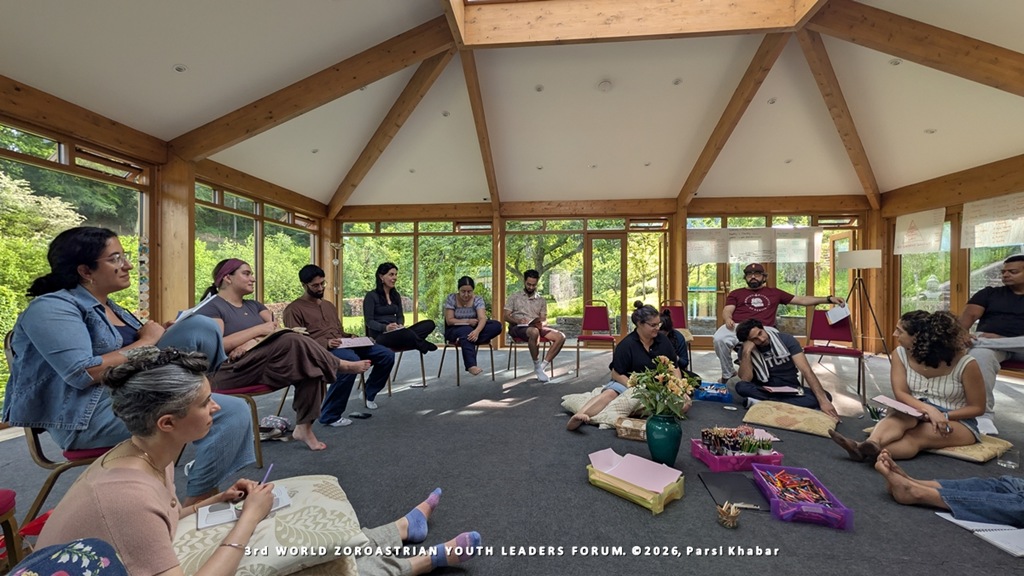
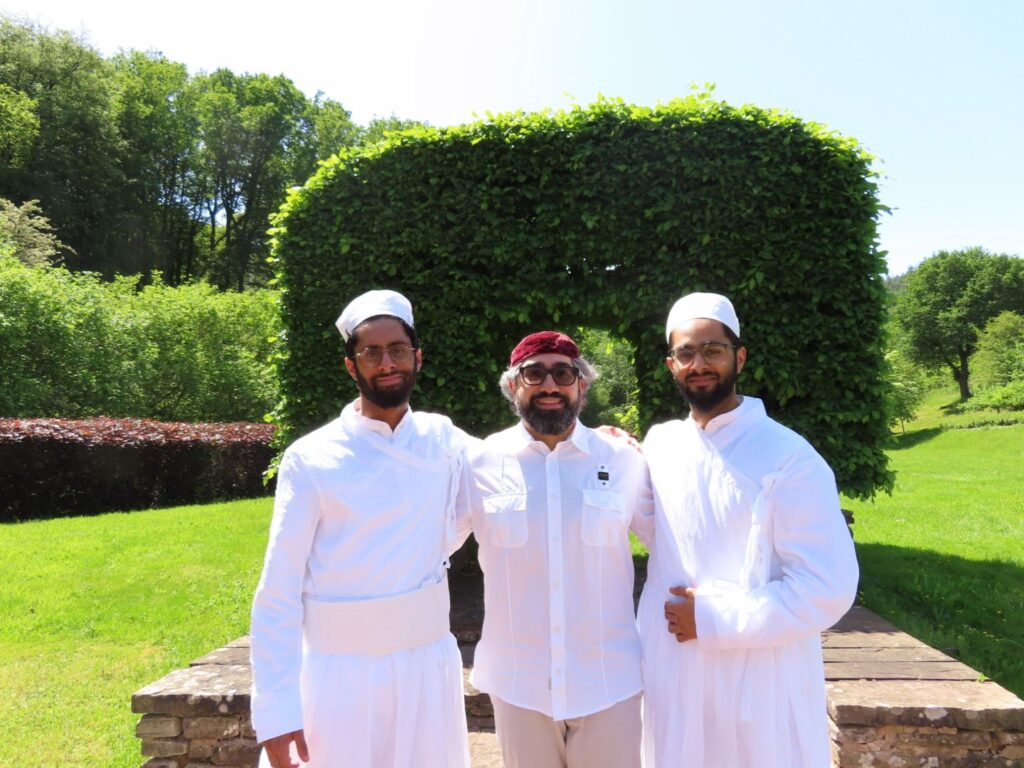
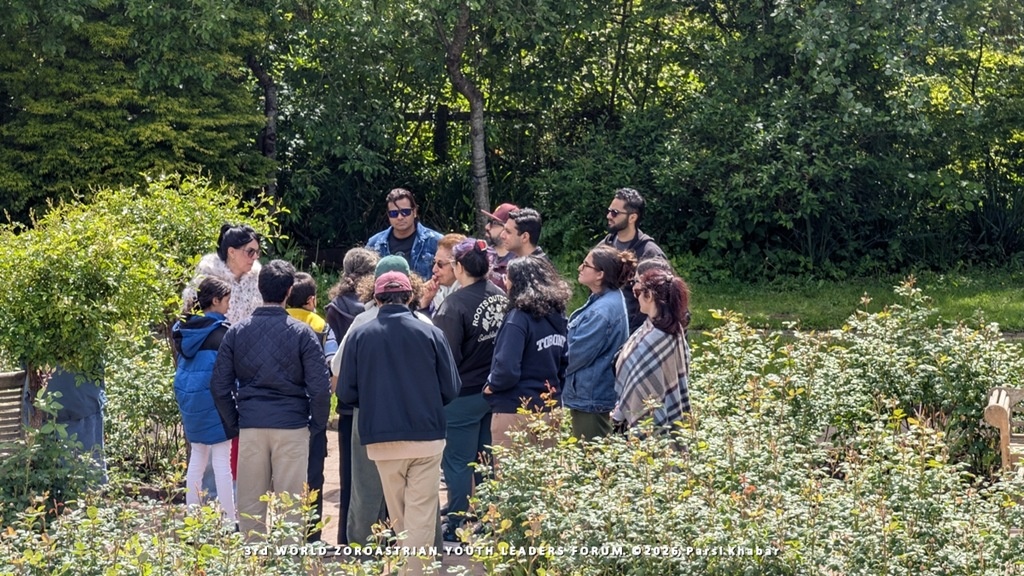
Beyond that, these affinities are not merely theoretical: they find contemporary expression in initiatives such as the World Zoroastrian Youth Leaders Forum (WZYLF), which recently brought together young Zarathushti leaders from across the world at the ASHA Centre in the ancient Royal Forest of Dean in the United Kingdom, where J R R Tolkien was inspired to write the Lord of the Rings. The enabler of this forum is Zerbanoo Gifford, renowned author, human rights advocate, and founder of the ASHA Centre, whose work over decades has extended far beyond the Zoroastrian community to encompass global engagement in intercultural dialogue, education, environmental responsibility, and notably anti-slavery. It is in this spirit that she has described the WZYLF as a space designed “to empower young leaders from around the world through a dynamic series of workshops, dialogue, and interpersonal exchange, fostering innovation and promoting cross-cultural understanding,” while also emphasizing that participants “have been invited based on their leadership qualities, demonstrated commitment to community service, and potential to make contributions to local and global communities.”
The WZYLF is not simply an event, but a global community bringing together diverse perspectives into a shared space of learning and co-creation. Participants lived, worked, and celebrated together, exploring their own journeys while collectively imagining the future of their community and the impact of their academic, entrepreneurial, societal, philanthropic, or artistic work. They learned from leaders of very different fields of life, including scholars such as Professor Yuhan Sohrab-Dinshaw Vevaina of the University of Oxford, award-winning chef Tanaz Godiwalla, known in India as the “Queen of Parsi Cooking”, the Executive Director of London’s Marylebone Theatre Adrian Locher, and the former Leader of the House of Lords, Baroness Jan Royall.
What emerges from such a setting is more than individual development. It is the formation of a network: an emergent infrastructure of relationships, ideas, and projects that extend far beyond the immediate experience. Indeed, participants develop concrete initiatives ranging from educational tools and language preservation to global directories and support networks, all aimed at strengthening the worldwide Zoroastrian community.
Perhaps the reflections of the University of Oxford’s Dr. Arash Zeini, who contributed to the Forum as a scholar of Zoroastrianism, summarized it best. He described the experience as “transformative,” marked above all by “the positive energy of the young people involved” and the impression that “all seemed to point towards a bright future.”
This combination of structured collaboration, intangible atmosphere, and optimism, even in our times, is not incidental. It reflects a deeper insight: communities are sustained not only by shared beliefs, but by lived connections. Or, in Zoroastrian terms, by the continuous practice of good thoughts, words, and deeds within a relational framework.
It is here that Hamburg re-enters the picture: for what is a Hanseatic city, historically, if not a network? The medieval Hanse itself was less a territory than a system of trust-based nodes, enabling commerce, communication, and exchange across vast distances. Its success did not depend on central authority, but on shared norms and on the expectation that agreements would be honoured, that commitments were meaningful, and that actors would behave in ways that sustained the system as a whole. Mumbai offers a different, but strangely resonant, example. There, Parsi entrepreneurs and business families helped shape not only companies, but a civic world: mills, ships, institutions, schools, hospitals, housing, scientific ambition, and philanthropic foundations. Their legacy is not reducible to wealth creation, impressive though that was. It lies also in the conviction that enterprise carries obligations beyond itself. The company, in this imagination, is never only a private instrument of profit. It becomes part of the architecture of society. Seen from Hamburg, this is strikingly familiar: the port city and the Parsi metropolis meet in the idea that commerce must generate trust, and that trust must eventually become institution. In an age of increasingly mobile capital, dispersed ownership, and short-term incentives,both Hamburg’s Hanseatic tradition and Mumbai’s Parsi legacy ultimately point towards the same question: how can societies create the conditions in which entrepreneurial success once again translates naturally into long-term investment in the communities and institutions from which it emerged?
The analogy may be more suggestive than strictly historical, but it is not arbitrary. Both the Hanseatic tradition and contemporary Zoroastrian initiatives such as the WZYLF operate through distributed networks grounded in ethical assumptions. Both rely on individuals who internalize responsibility rather than externalize it. And both demonstrate that sustainable systems, prosperous ecosystems, and societies at peace are ultimately built on trust.
As a Hamburg-born, Hamburg-based participant at the World Zoroastrian Youth Leaders Forum, I experienced the invitation as both a great honour and a moral obligation. It became less a coincidence than a point of convergence, an inspiring moment in which two historically distinct yet structurally resonant traditions intersect.
Both Hamburg and the WZYLF also serve as reminders that humanity’s futures are shaped not only in political capitals or formal institutions, but in communities that cultivate openness, responsibility, and connectivity over long periods of time. Hamburg, with its large Iranian diaspora and its position within European networks of trade, research, and culture, is precisely such a place, and so are Mumbai, London, Singapore, New York, Toronto, and the other cities of origin of the participants of the WZYLF.
The young leaders who gathered at the ASHA Centre are, in a sense, carriers of this process: translating tradition into action, local experience into global connection, and ethical principles into concrete initiatives. And perhaps this brings us back to where we began: that a participant from Hamburg was the first from Germany to join this global network is, ultimately, a small fact. Yet it gestures toward a larger question: how communities and traditions, separated by geography and history, may nevertheless recognize themselves in one another.
In that recognition, beyond the dimensions that often otherwise divide us, whether rural areas or cities, long-established residents or recent arrivals, Parsi or Persian, lies potential not only for dialogue, but for collaboration. And, if we take seriously both the Hanseatic and the Zoroastrian insistence on responsibility, for a form of global connectivity that is not merely efficient, but ethical and social-entrepreneurial. We will soon see, as outputs and outcomes of the WZYLF, the implementation of concrete projects across a wide range of fields currently being developed by international, interdisciplinary, and intergenerational teams that met during the Forum.
To return one final time to a principle shared between Hamburg and the Zoroastrians: a community, embedded in highly different societies around the world and built on millennia of spiritual and philosophical thinking, can impact these societies in a way which hopefully will allow us, as humanity, to one day sleep peacefully at night.
Written by Manouchehr Shamsrizi
About the Author
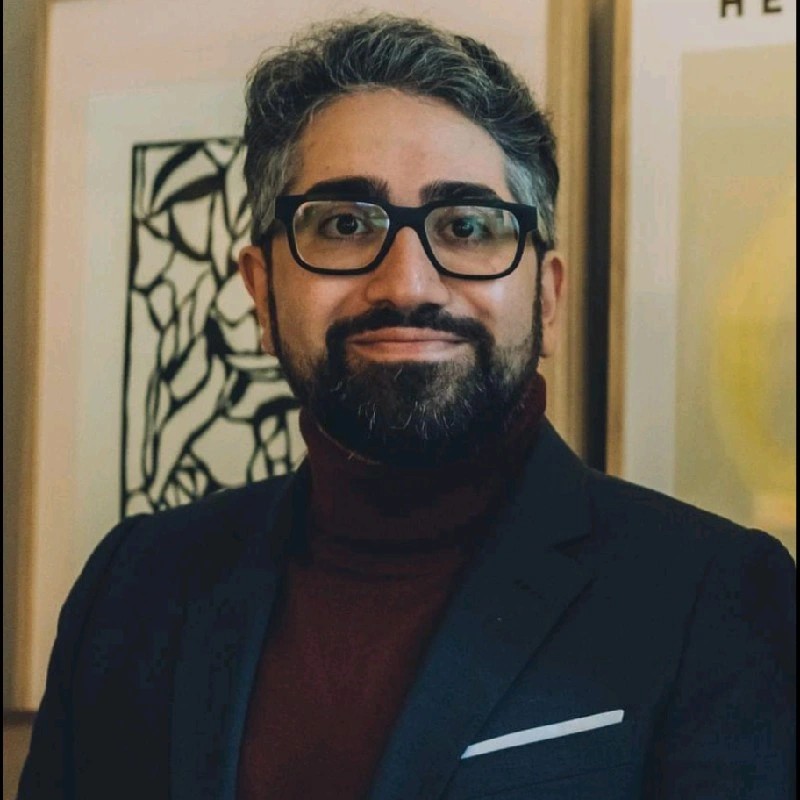
Manouchehr Shamsrizi, M.P.P. FRSA, is a Hamburg-based entrepreneur, researcher, and lecturer of Persian-Zoroastrian heritage. He is the co-founder of Quantum Entertainment Berlin, a British-German quantum and gaming startup, as well as the gamelab.berlin at Humboldt-Universität zu Berlin. A former Fellow at the universities of Cambridge and Yale, a lecturer at the WHU – Otto Beisheim School of Management, and an Adjunct Professor at Touro University Berlin, he has been recognized internationally for his work on deep technology, entrepreneurship, and social innovation.